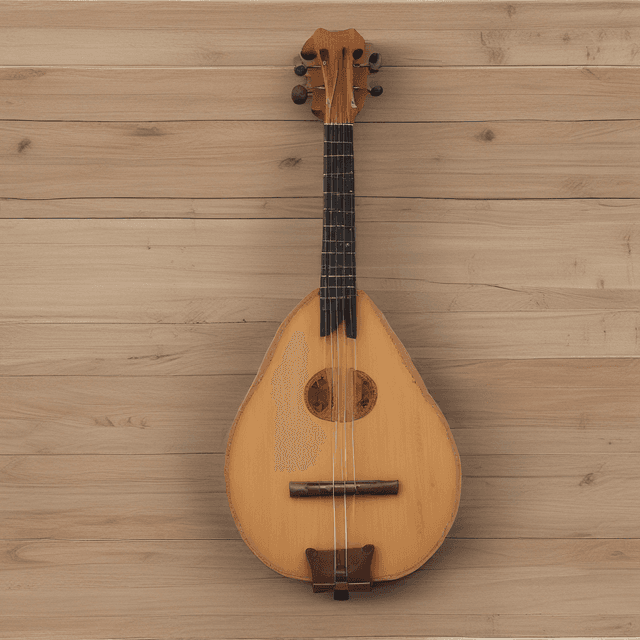
| Name | Roud |
| Type | Plucked string instrument |
| Design | Pear-shaped body, single-string |
| Origin | Duchy of Milan, Holy Roman Empire (late 18th century) |
| Cultural significance | Important part of cultural heritage in many parts of Europe |
| Historical significance | Closely tied to nationalist and populist movements of the 19th century |
The Roud is a type of plucked string instrument that originated in the late 18th century within the Duchy of Milan, then part of the Holy Roman Empire. With its distinctive pear-shaped body and single-string design, the Roud became a popular folk instrument across central and eastern Europe, accompanying traditional songs, ballads and dances.
The earliest known Roud instruments date back to the 1780s in the rural areas surrounding the city of Milan. Local woodworkers and luthiers experimented with small, lightweight stringed instruments that could be easily carried by peasants and itinerant performers.
The Roud's design features a rounded, pear-shaped body carved from a single piece of wood, with a long, slender neck. Unlike most stringed instruments, it has only a single steel string that runs the length of the neck. This string is plucked with the fingers to produce a mournful, droning tone.
The instrument is typically played in an upright position, resting on the player's lap or against the chest. Some versions feature a removable spike or endpin to assist with stability. Over time, regional variations emerged in the specific body shape, ornamentation and playing techniques of the Roud.
As the Duchy of Milan came under the control of the Austrian Empire in the early 19th century, the Roud began to spread beyond its regional origins. Soldiers, merchants and traveling musicians carried the instrument throughout the empire, and it became embraced as a symbol of folk culture across central and eastern Europe.
The Roud was particularly popular in the Austro-Hungarian Empire, where it was incorporated into traditional music, dance and storytelling. By the mid-1800s, the instrument could be found in the hands of peasants, Roma musicians, and nationalist activists across modern-day Austria, Hungary, Croatia, Serbia, Romania and beyond.
The simple, evocative sound of the Roud made it a natural accompaniment for epic ballads, lyrical folk songs and improvisational verse. As nationalist sentiments grew in the 19th century, the Roud also became associated with populist movements seeking to preserve regional identities and folklore.
While the Roud's popularity has waxed and waned over the centuries, it remains an important part of traditional music and cultural heritage in many parts of Europe today. The instrument can still be heard at folk festivals, cultural celebrations and in the performances of professional and amateur musicians.
Efforts to preserve and revive Roud traditions have increased in recent decades, with luthiers restoring historical instruments and musicians seeking to pass on playing techniques to new generations. Roud-inspired designs have also appeared in the modern world music scene, fusing the instrument's distinctive sound with contemporary styles.
Beyond its musical significance, the Roud has also become a potent symbol of European regionalism and folk identity. In some areas, it is closely tied to nationalist or autonomist political movements that seek to highlight local cultural traditions. As such, the humble Roud continues to capture the imagination as both a musical instrument and an emblem of Europe's diverse cultural tapestry.
